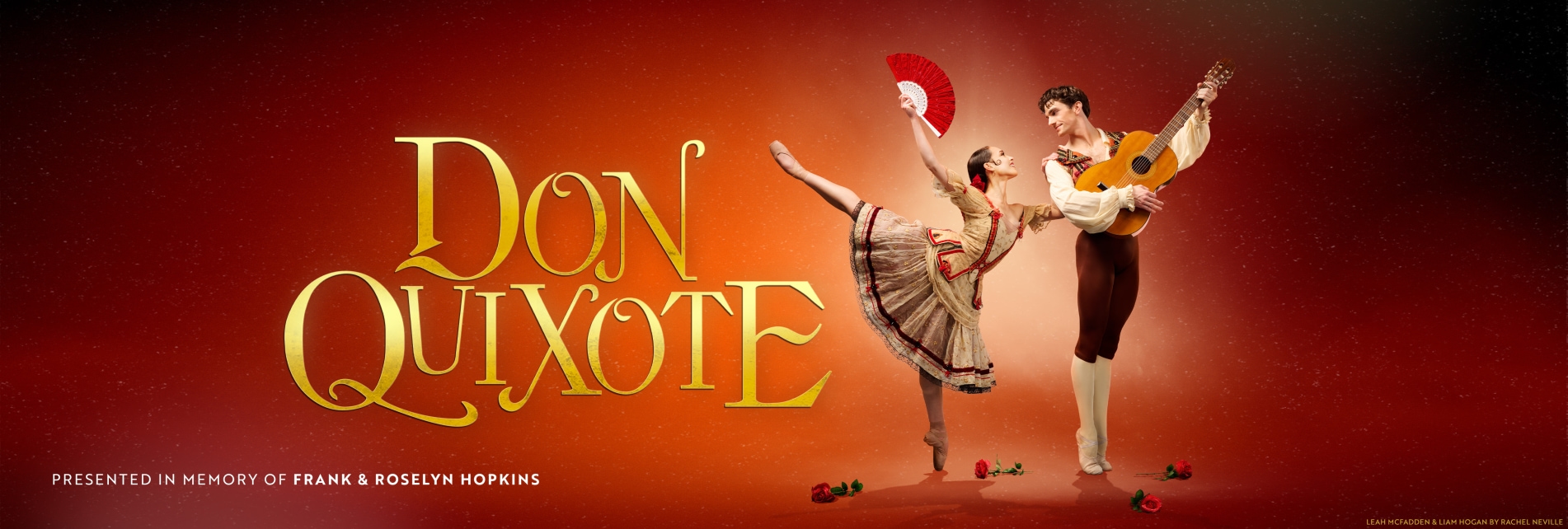
Prologue: Driven by the vision of Dulcinea, Don Quixote begins his adventures with his trusty squire, Sancho Panza, in tow.
Act I. A market place in Seville. Kitri, Lorenzo’s daughter, is in love with Basilio. Much to her chagrin, she learns of her father’s plans to marry her
to Gamache, a foppish nobleman. Don Quixote and Sancho Panza enter the village, causing great commotion. Noticing Kitri, Don Quixote wonders if he has, at last, found his Dulcinea, the woman
of his dreams. At the height of merriment, Kitri and Basilio, aided by their friends, Espada and Mercedes, sneak off followed by Don Quixote and Sancho Panza. Gamache and Lorenzo
attempt to pursue the young couple.
Act II. Scene 1: Romani Camp. Don Quixote and Sancho Panza discover the fleeing couple in a lively Romani camp. All are inspired by the romance of the
night. As the vision of Dulcinea appears to him, Don Quixote realizes Kitri is not his “ideal,” but indeed belongs with Basilio. Suddenly the wind gains momentum. Don Quixote
foolishly attacks a windmill, believing it to be a giant threatening Dulcinea’s safety. Failing miserably, he collapses into a deep sleep.
Act II. Scene 2: The Dream. Don Quixote has an enchanted dream of beautiful maidens in which the image of Kitri symbolizes his Dulcinea.
Act II. Scene 3: Sunrise. Awoken from his dream by Sancho Panza, Don Quixote is sympathetic to the plight of the young lovers. Don Quixote attempts to lead Lorenzo
and Gamache astray in their search for the young lovers.
Act II. Scene 4: A Tavern. Kitri enters with Basilio and they join in the dancing. Lorenzo and Gamache enter looking for Kitri. Basilio draws a knife and pretends
to stab himself. Kitri implores Lorenzo, her father, to unite her with Basilio as his dying last wish, but Lorenzo refuses. Don Quixote appears with Sancho Panza and challenges Lorenzo for
refusing a man’s dying wish. Lorenzo then agrees to unite Basilio and Kitri. At this moment Basilio returns to life, admitting he was only playing a joke. Triumphantly, Kitri leaves to
prepare for marriage while Don Quixote and Basilio salute Lorenzo and Gamache for stoically accepting the inevitable.
Act III. The Wedding. The village celebrates the marriage. Don Quixote congratulates the couple, bids them a warm farewell, and resumes his ever-lasting
adventures.